
As promised, here's the details on my conference dress.
The fabric reminded me more of a man's shirting fabric than lady's dress fabric (sorry Carolann!) and it just wasn't "speaking" to me, so I contemplated how I could change the fabric....

And then I remembered the indigo dyeing class I had taken in the summer!
I considered dyeing the entire dress length, but indigo dyeing is best done outdoors, being both smelly and messy, and that was just not an option in January on Mackinac. So I decided to just dye enough for trim, but I still didn't have any particular design in mind.
So back to the books, but none of the fashion plates or photos of originals were giving me any inspiration, until....

I found this gown, which is in the collection of the Victoria & Albert. It has a surplice style bodice and a separate draped overskirt and lots of trimmings. While looking through the fashion plates and photos of originals, I had noticed that most black and white print dresses were post-War or early 1870's, and the V&A gown dates to 1868. While researching for my servant presentation, I had found innumerable references to servants wearing overly stylish clothing made in inappropriate fabrics - thus my use of cotton to create an interpretation of a gown that was originally silk.
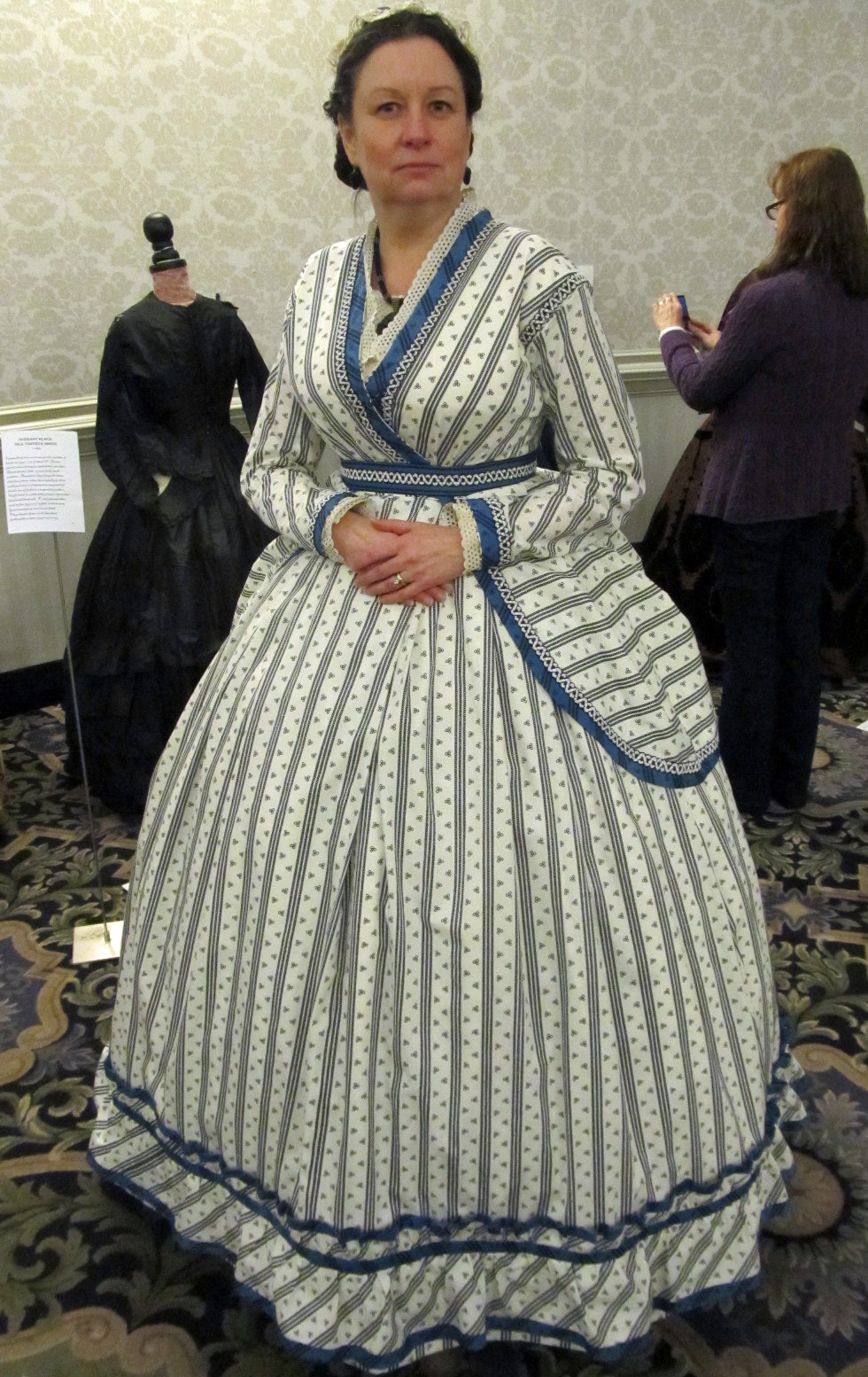
The surplice bodice was surprisingly easy to draft; it was really just an adaptation of my custom fit darted bodice pattern. The sleeves are coat style and the skirt has a bias cut ruffle, gathered on a cord and bound with the dyed fabric. Period ruffles were not generally very full, only about 1/3 fuller than the skirt - in my case, my skirt is 180" around and my ruffle is 240". Too full ruffles tend to give a bit of the "Holly Hobby" look - not a good thing!

The draped overskirt is mounted on the belt - no images of the back of the inspiration gown were available, so I had only the written description to go by, so my choice may or may not emulate the original. The skirt on the original was gored, much fuller to the back and worn over an elliptical skirt support. I don't have an elliptical hoop and didn't want to deal with drafting a gored skirt, so I choose to gauge 60" of skirt down to 10" for the very back of the skirt and made one large box pleat in the front with small directional pleats over the hips - it shifted the bulk of the skirt to the back and resulted in a somewhat flat front - exactly the type of style compromises a servant might make when trying to go high style on a low budget.
I also created a little cap for this ensemble - separate post to come.


