
Sunday, October 20, 2013

Monday, October 14, 2013

Monday, October 7, 2013

Sunday, October 6, 2013

Thursday, October 3, 2013
Seasonal Signs

Life on Mackinac is cyclic - and I don't mean bicycles!
As summer passes and we move into fall, there are certain signs that the season is changing and one of the most telling is the gradual, annual movement of the horses back onto the mainland.
I'm sure these were not the first batch to make the move, but they are the first I've seen. It's a bit bittersweet to see them go, but it's just part of the rhythm of life on this Island.
I recently became aware of a very special program filmed in 1988, When the Horses Leave: Metamorphosis at Mackinac. You can see the online version here.

It was made 25 years ago, but still illustrates the lifestyle of year round Mackinac today and it's great fun to watch and compare how some of our residents looked a quarter century ago!
Tuesday, September 24, 2013
History: On the Table
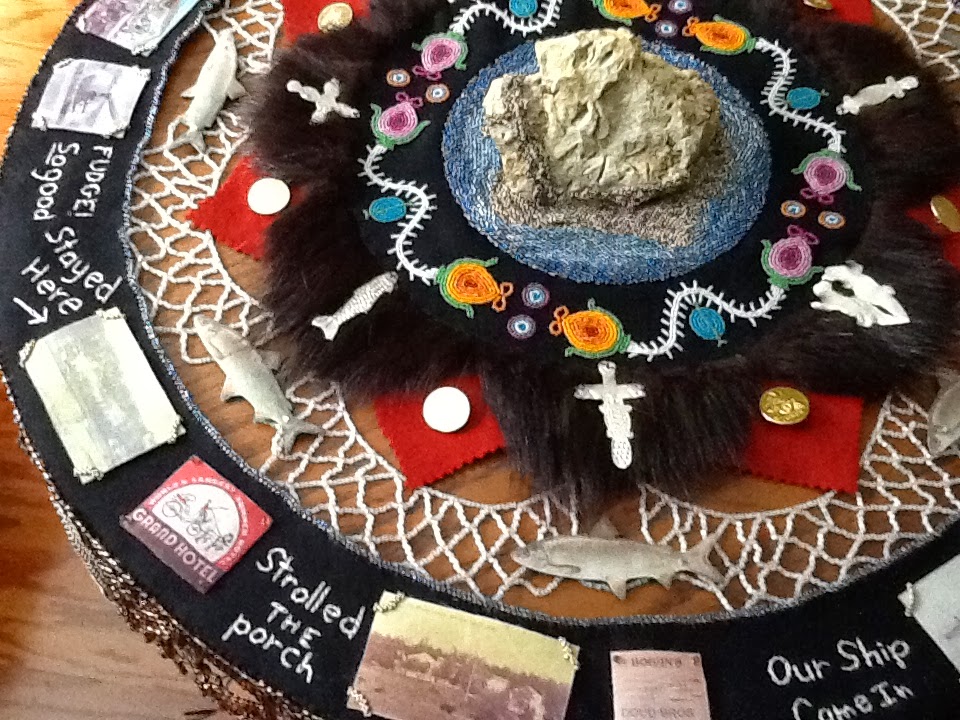
My work has been gradually moving in a more mixed media direction, but always with beads as the centerpiece. "History: On the Table" is my most ambitious example of this concept to date.
The piece was originally created for the 2013 contemporary exhibit at the Richard and Jane Manoogian Mackinac Art Museum, this year's theme was "People of Mackinac". My intent was to represent ALL the people of Mackinac, from beginning to the present in a mandala form.
Alas, the piece was rejected by the juror!
But it WAS accepted for the 2013 Crooked Tree Art Center Juried Fine Art Exhibition - YAY!
The Island itself is represented at the center, by a piece of the brecciated limestone. It's held in place by a beaded "bezel", that extends up and over the stone.

An island is, of course, surrounded by water and so is my representation - I used over twenty different colors of beads in an attempt to capture the ever changing nature of the lake.

The first people to represented are literally the First People in this area, the Anishinaabe (Ojibwa) Indian tribes were some of Mackinac Island's first known inhabitants, who considered the island to be the sacred home of the Gitche Manitou, or the "Great Spirit".

Originally, Native American beads were carved from natural materials like shells, coral, turquoise and other stones, copper and silver, wood, amber, ivory, and animal bones, horns, and teeth. Glass beads were not used until colonists brought them from Europe 500 years ago and were quickly became the the beads of choice.
The traditional motifs were curving, especially a double curve and often included abstract floral designs. I chose to not replicate an original design, but created my own pattern, keeping the established motifs in mind.
My design is stitched on black wool, using opaque size 15/0 beads.


The next people to be represented were the French fur trappers.

I used actual beaver fur, cut in scallops and also created my own fur trade silver pieces, using PMC.
The black wool and the silver crosses were also used to represent the Jesuit missionaries, who established the first mission on Mackinac in 1670.

The next ring in the mandala depicts the British presence with red wool I purchased from a gentleman who constructs reproduction British redcoat uniforms as well as shiny military buttons (not in this picture).
Soon after the British lost possession of Mackinac, the fur trade was over and the residents farmed and especially fished - the waters surrounding Mackinac teemed with fish, particularly desirable whitefish. The wharfs, warehouses and workforce that so effectively served the fur trade were easily adapted to commercial fishing.
I created beaded nets for the next round:

And linked the nets with a school of image transferred whitefish.

As with furs, the fishing industry also crashed, due to over fishing. The residents of the Island needed a new industry and steamships and trains brought to them - the tourist trade!
Tourists have become a dominant people on Mackinac starting in the 1850's and continues to the present day.

I was at a bit of a loss on how to depict such a long range of time: 1850 - the present, but decided to emulate an old fashioned photo album. You might recall the style: black paper pages, photo corners and notes made with a white pencil.
A new question arose - how to display this assemblage?
The answer - more assemblage!
I had an old, broken Victorian era table that I've been hauling around for years, to my husband's dismay.
The table top was square, but we cut it into a circle, perfectly sized to hold the mandala. Then a beat-up metal wheel was inserted in place of the broken shelf, as a reference to the wheeled vehicles we use, bikes and buggies.

After placing the mandala on the table, all I could think of was a doily, albeit a rather eccentric doily. And doilies usually have an edging or fringe, so mine did too!
My fringe pulls together past and present, after all, the present is deeply rooted in our past - thus beaded roots with beaded mirrors, to make the viewer a part of the people of Mackinac.

Here's an overall view:

It's all there, the history of a place and the people who have made it: "Our History: On the Table".
Sunday, September 22, 2013
Crooked Tree Art Center - Juried Fine Arts Exhibition 2013

I was thrilled to have TWO pieces accepted in to the 2013 Juried Fine Art Exhibition at the Crooked Tree Art Center!
The above photo is of "History: On the Table" - my most mixed media piece to date, but it still has beads. I will have a more detailed post about this piece soon.

Also accepted was "The Foundation or In the Beginning", AKA "Stumpy".
The show runs until November 8th, if you find yourself in the Petoskey area, consider dropping in - there's a couple other excellent shows up too.
Subscribe to:
Posts (Atom)
