Showing posts with label museum. Show all posts

Thursday, June 11, 2015

North of 45 Opening - 2015


We were able to attend the opening of this years North of 45 and  I loved the placement of "Our History: On the Table - right near the front, sure to be seen!


I spent quite a bit of time talking to attendees, and was pleasantly surprised at the reception the piece received - it's certainly not a mainstream example of art, but people really seemed to enjoy seeing history shared in an alternative manner.


I had encouraged fellow Mackinac Island artist Jamie Andress to enter - he did and had TWO pieces accepted!


And he sold one - congratulations Jamie!

Thursday, June 4, 2015

North of 45 - 2015


The North of the 45th is an annual juried exhibition of artists living in the geographical area north of the 45th parallel in Michigan, Wisconsin and Minnesota. This line is known as the halfway point between the equator and the north pole, and crossing this line from the south is often associated with being "up north." This exhibition showcases the breadth and depth of artists living in this upper Midwest region from both rural and urban areas. Each year a different juror is asked to select pieces for the exhibition from an open call for entries.


Currently Curator of Exhibitions at the Racine Art Museum, where she oversees the production and implementation of 10-15 exhibitions per year, juror Lena Vigna has a particular interest in the contemporary fields of adornment, sculpture, fiber, and installation. Lena has curated numerous solo and group exhibitions and written several essays that explore issues relevant to contemporary art and society.


A Juror's Choice award will be selected by the juror, with a prize of $500. An Audience Choice award in the amount of $250 will be given at the close of the exhibition, based onvotes by visitors to the exhibition.


Featuring work by: Will Agar, Kjellgren Alkire, Jamie Andress, Ezra Asohan, Brendan Baylor, Julie Benda, Kimberly Benson, Gregg Bruff, Tomas Co, Eileen Cohen, Samantha Corbett, Debbie Covart, Melissa Davidson, Dominic M. Davis, Andy Delany and Lauren Flynn, Gretchen Dorian, Kelly Dorman, Pete Driessen, Michael Eble, Jonathon Engelien, Kiera Faber, Nina Fiorucci, Jessie Fleury, Cynthia Foley, Michael Friend, Stacy Giroux, Greg Green, Mike Hainstock, Lindsy Halleckson, Lindsey Heiden, Matt Hirvonen, John Hubbard, Steven Hughes, Carol Irving, Dustin Johnson, Brian Kakas, Keith Kaziak, ReneƩ Kirchenwitz, Jim Krausman, Barret Lee, Scott Leipski, Christine Lenzen, Michael Letts, Alex Maier, John McCoy, John McKaig, Renee Michaud, Susan Mikutowski, Jessica Mongeon, Eric Mueller, Craig Neeson, Paul Nelson, Tilton + Oeler, Russell Prather, Kyle Rambatt, Amy Rice, Eileen Rieman-Schaut, Paul Rose, Patrick St. Germain, Alanna Stapleton, Holly Streekstra, M. Parker Stuart, Tracy Wascom, Lyz Wendland.

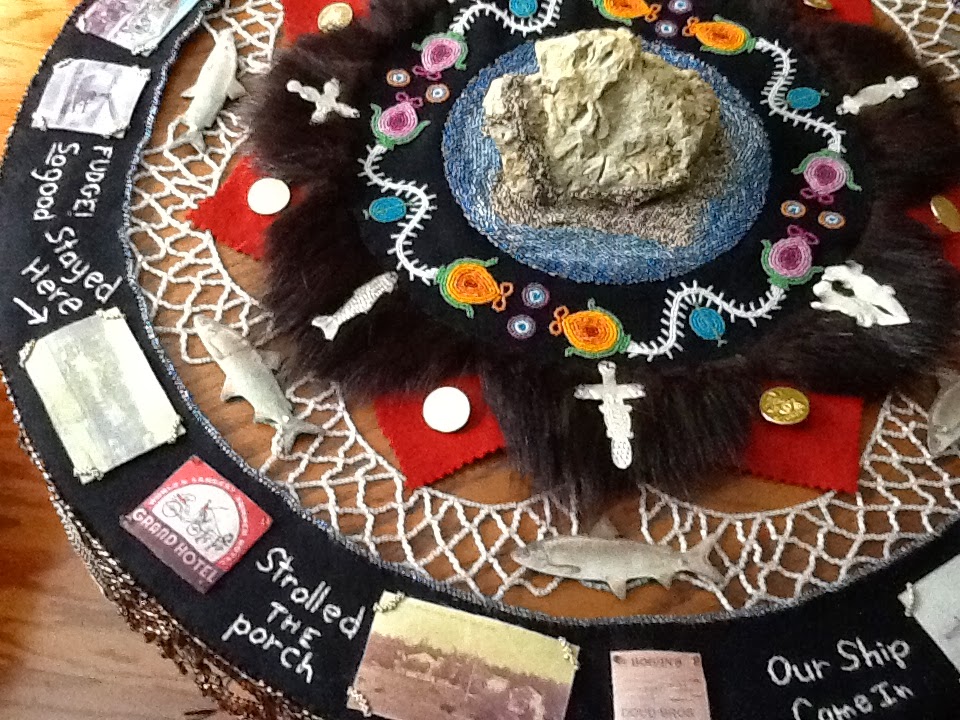
My piece is "Our History: On the Table; it's a history of the people of Mackinac Island, from the distant past to the present.


For a full explanation of the piece and many more photos, click HERE.

We'll be at the opening tomorrow evening and can't wait to see the entire show!

Tuesday, May 13, 2014

Places of Mackinac Exhibit


I'm very pleased to have had  a piece accepted into the 2014  "Places of Mackinac" art exhibit at the Richard and Jane Manoogian Mackinac Art Museum... and a photograph no less, the first time I've had a photo on public exhibit.

My photo is entitled "Winter Blues" and depicts foot thick slabs of ice, piled on the shore of the Island. This ice is bright blue and glows against the gloomy grey sky, absorbing and reflecting every bit of ambient light.  

How is this a "place" of Mackinac?

Well, every island is ultimately defined by water and for the year round residents of Mackinac, winter's ice and it's impact on our lives,  is most certainly a "place"!

If you're visiting Mackinac Island this summer, do try and make time to visit our art museum - the permanent collection is fabulous and the seasonal, juried exhibit is always a pleasure too!

Tuesday, September 24, 2013

History: On the Table


My work has been gradually moving in a more mixed media direction, but always with beads as the centerpiece. "History: On the Table" is my most ambitious example of this concept to date.

The piece was originally created for the 2013 contemporary exhibit at the Richard and Jane Manoogian Mackinac Art Museum, this year's theme was "People of Mackinac". My intent was to represent ALL the people of Mackinac, from beginning to the present in a mandala form.

Alas, the piece was rejected by the juror!

But it WAS accepted for the 2013 Crooked Tree Art Center Juried Fine Art Exhibition - YAY!

The Island itself is represented at the center, by a piece of the brecciated limestone. It's held in place by a beaded "bezel", that extends up and over the stone.


An island is, of course, surrounded by water and so is my representation - I used over twenty different colors of beads in an attempt to capture the ever changing nature of the lake.


The first people to represented are literally the First People in this area, the Anishinaabe (Ojibwa) Indian tribes were some of Mackinac Island's first known inhabitants, who considered the island to be the sacred home of the Gitche Manitou, or the "Great Spirit".


Originally, Native American beads were carved from natural materials like shells, coral, turquoise and other stones, copper and silver, wood, amber, ivory, and animal bones, horns, and teeth. Glass beads were not used until colonists brought them from Europe 500 years ago and were quickly became the the beads of choice.

The traditional motifs were curving, especially a double curve and often included abstract floral designs. I chose to not replicate an original design, but created my own pattern, keeping the established motifs in mind.

My design is stitched on black wool, using opaque size 15/0 beads.


The next people to be represented were the French fur trappers.


I used actual beaver fur, cut in scallops and also created my own fur trade silver pieces, using PMC.

The black wool and the silver crosses were also used to represent the Jesuit missionaries, who established the first mission on Mackinac in 1670.


The next ring in the mandala  depicts the British presence with red wool I purchased from a gentleman who constructs reproduction British redcoat uniforms as well as shiny military buttons (not in this picture).

Soon after the British lost  possession of Mackinac, the fur trade was over and the residents farmed and  especially fished - the waters surrounding Mackinac teemed with fish, particularly desirable whitefish. The wharfs, warehouses and workforce that so effectively served the fur trade were easily adapted to commercial fishing.

I created beaded nets for the next round:


And linked the nets with a school of image transferred whitefish.


As with furs, the fishing industry also crashed, due to over fishing. The residents of the Island needed a new industry and steamships and trains brought to them - the tourist trade!

Tourists have become a dominant people on Mackinac starting in the 1850's and continues to the present day.


I was at a bit of a loss on how to depict such a long range of time: 1850 - the present, but decided to emulate an old fashioned photo album. You might recall the style: black paper pages, photo corners and notes made with a white pencil.

A new question arose - how to display this assemblage?

The answer - more assemblage!

I had an old, broken Victorian era table that I've been hauling around for years, to my husband's dismay.

The table top was square, but we cut it into a circle, perfectly sized to hold the mandala. Then a beat-up metal wheel was inserted in place of the broken shelf, as a reference to the wheeled vehicles we use, bikes and buggies.


After placing the mandala on the table, all I could think of was a doily, albeit a rather eccentric doily. And doilies usually have an edging or fringe, so mine did too!

My fringe pulls together past and present, after all, the present is deeply rooted in our past - thus beaded roots with beaded mirrors, to make the viewer a part of the people of Mackinac.


Here's an overall view:


It's all there, the history of a place and the people who have made it: "Our History: On the Table".
Saturday, September 14, 2013

A Fashion Timeline


We recently visited the Indianapolis Museum of Art and encountered this fashion timeline - all constructed of plain cotton fabric and only about three foot tall.

The signage encouraged touching and even gave directions on what to look for underneath, for instance, the cage crinoline under the 1860 example.


I found it to be very well done - the use of a single neutral fabric, really highlighted the lines of each dress, without overlooking the typical placement of trimmings for each era.

I was also pleased by each having proper underpinnings too; I know I've frequently been asked "what's under there" when dresses in period clothing and I'll usually oblige with an explanation and a bit of lifting my skirts.

Perhaps another project....


Monday, April 1, 2013

Reproduction? Or Interpretation?


This is the cap/headdress/bit of foo foo (pick your term) that I created to wear with my 2013 conference dress. I was inspired by a piece I had first spotted on an online auction site, and purely by happenstance, it was one of many original garments on display on Saturday, when I wore mine - here's the original:


And a bit closer:

The original illustrates a number of very typical period techniques:

 - The use of coordinating but not necessarily matching materials. The center square is light and airy and the surrounding lace matches it nicely in weight and color.

- The lace and ribbon have been manipulated to to minimize the need for cutting, keeping the materials in one piece as much as possible; this maximizes the potential to deconstruct the cap and reuse the trims in a new garment.

- It has been constructed completely by hand, with what many would consider large crude stitches; this is intentional, again to aid in reusing the materials.


I duplicated these techniques - all the materials are from my stash, with the center square being a real salvaged piece - it was very dark and stained, but cleaned up beautifully. The materials are heavier in weight than the original, but coordinate well in both color and texture. I used just a single round of velvet ribbon, as mine was wider than the original. I also constructed my bow a bit differently, as I had a length of of the tiny ribbon which matched perfectly. The lace and ribbon are both left in long, uncut lengths.


It is stitched entirely by hand - in the car, on the way to Pennsylvania in fact!

When I was finished, I was a bit panicked - it seemed so small! But actually, it was just right, the same size as the original.

Many people would say I had created a reproduction of the original - but did I really?

I think a better example of a "reproduction" garment would be the two replicas of Emily Dickinson's famous white dress, commissioned by the Emily Dickinson Museum, to be displayed when the original became too fragile.
A pattern was created by painstaking measurement of the original dress and a muslin sewn to check the accuracy of the pattern.

Context Weavers, an English firm, exactly duplicated the fabric by punching a custom set of cards to be used on their Jacquard loom. The embroidered insertion and edging trim was reproduced by an American company.

While finding firms able to recreate the proper materials was difficult, a larger challenge was finding the funding - $10,000 for the two replicas.

Another good example is the Plimoth jacket, and even that's not considered to be a true reproduction - it's actually based on two separate garments.

I would argue that I created an interpretation of the original; the influence can be seen, but they are certainly not identical.

And I would further argue, that's the norm - there are vary few individuals with either the skill set or the budget to create true reproductions, we're all creating interpretations!

Sunday, September 30, 2012

Taking to the Waters: Male Bathing Costume Construction Details


If you ask most reenactors what men wore to swim in during the mid-19th century, you would probably be told "nothing - men always swam in the nude."

Well, I'm sure there certainly were times when men swam in their skin, but a bit of research tells us that it was definitely not a case of "always". 


This scene, "The Bathe at Newport", by Winslow Homer circa 1858, shows a good reason why - in America, bathing was not gender segregated, as on the continent - and while the Victorians were not the prudes they are ever so frequently portrayed as, group nude bathing was definitely not a socially acceptable activity! 

Clues to what men actually did wear, are tantalizingly few. I choose to use this example in the collection of the McCord Museum as my inspiration. The original is wool, trimmed with braid.


The museum's description notes that men's swimming suits of the period were closely styled on underwear - and that's exactly what I used for the basic shapes when creating my custom pattern.


I took the pattern pieces for men's drawers and a square shirt and combined them into one piece. 


My initial "muslin" (actually an old flannel sheet) was a bit short in the torso, so I added an additional 3" - thus, the piecing you can see on the muslin.
 
When I first asked Robin if he would be willing to wear a period bathing costume, he readily agreed: if it was ORANGE, so if he ended up floundering in the waves, we could find him. As fate would have it, on our first attempt to find appropriate fabric, what did we find but bright orange wool! However, it was blanket weight and would have had him floundering in the waves for sure, so we settled on this color scheme instead


And behold, my version of an 1860's male bathing costume, which has come to be nicknamed the "Civil War Onsie"! It was never my intention to 100% replicate the McCord Museum piece, but to use it as reference. The basic shape is very close, but I used bands of red wool as my trimming and the mother of pearl buttons were great accents.


As the "test driver" so to speak, Robin reports that it is both functional and comfortable.


Sunday, July 8, 2012

What Would You Do?

While visiting a small, volunteer based historic site, we encountered the following:


We've been involved with Civil War living history for a long time, but we've never encountered this bit of information before.

A quick google search shows many sites that discuss this story, interestingly enough, all with the identical wording.

Most also include another story, crediting George Washington as the source of the statues:

"The origin of the lawn jockey has been traced back to George Washington and the famous midnight crossing of the Delaware River on Christmas night. According to the story, among those with Washington was a twelve year old African-American named Jocko Graves. Graves wished to accompany Washington and the troops on the crossing but Washington felt it was too dangerous and charged Graves with staying behind with the horses. He ordered Graves to keep a lantern lit so that the troops upon their return could find their horses. After the raid against the Hessians, Washington and the troops returned to find Graves dead from exposure, his light still lit and in his hand. Washington was so moved that he commissioned a statue "Faithful Groomsman" to be made and placed by the young man's grave at his home Mount Vernon."


The Civil War story apparently can be traced to an article published in 1984 in National Geographic magazine, unfortunately I have not been able to find a copy of that issue. The writer shares a family history of the Underground Railroad and the statues - anyone thinking "Quilt Code"?

It seems fairly obvious that this is probably just the equivalent of a Civil War urban myth, in fact, a spokeman for the National Underground Railroad Freedom Center in Cincinnati has said that "there is no truth to the idea that lawn jockeys were used as part of the Underground Railroad."

Furthermore, experts, such as Ann Chandler Howell, who for 20 years has researched the cast iron industry of the 19th century, remain skeptical and have been unable to find any foundry records of production of such statues prior to the war years.


I'm well aware that in an uncertain economy, cultural sites are increasingly forced to rely ever more heavily on volunteers and donations and are sometimes pressured to display items that may not fit the objectives of the site.


My question is what is an appropriate response.action when you encounter such obviously erroneous information?


I would really like to hear from all my readers - the living historians, the artists, the Island enthusiasts, etc.