Showing posts with label fancywork. Show all posts

Wednesday, January 6, 2016

Found Another One!


I have a somewhat odd obsession: attempting to match surviving mid-19th century stitched artifacts to period published patterns.

And I've found another one!!!

The ubiquitous "Mrs. Jane Weaver" has presented us with a "Head-Dress for Breakfast" in the October 1864 Peterson's Magazine, described as follows:

Take a simple square of white tarleton, trim with narrow black ribbon, and pin it quite forward on the front of the head; and you have the head-dress complete. 

And I've previously created my interpretation, based on the original artifact, several years ago.

This is a case of finding something completely off topic while researching a specific topic; it seems to happen nearly every time I leaf through my Godey's and Peterson's, one of the reasons I prefer to take the time to go page by page, as opposed to doing an online search.


Here's the original artifact, the resemblance to Mrs. Jane Weaver's depiction is striking, although not identical; the maker altered the materials and colors to suit her needs.


And here's my interpretation, again altered a bit to suit my needs. Complete details here.

Thursday, June 5, 2014

GORGEOUS NOTHINGS: The Grave is the Ultimate Seal


I was recently invited to participate in a rather unique exhibit: The Gorgeous Nothings, based on the envelope poems of Emily Dickinson and held at Three Pines Studio in Cross Village, MI.

What's an "envelope poem"?

In the mid-1990s, while examining Dickinson material in the Amherst College Library, the literary historian Marta L. Werner came across a small, irregularly-shaped collage cut from recycled 19th-century envelopes and covered with writing in Dickinson’s unmistakably hieroglyphic script.

Enchanted, Ms. Werner started a search for similar items in other collections and found dozens, long familiar to Dickinson experts but never examined as a group. Most were less elaborate than the collage. Some consisted of semi-intact envelopes that had been gently pried apart at the seams and flattened out. Others were fragments: torn-off corners of envelopes, detached flaps.

Whatever their configurations, the pocket-size papers shared one feature: sentences, stanzas and entire roughed-out poems pencil-written by Dickinson herself.

Now all the known “envelope poems” — 52 — have been gathered into a book called “Emily Dickinson: The Gorgeous Nothings,” published by New Directions and the art dealer Christine Burgin. 

My chosen envelope poem was A842:
As there        are
Apartments        in our
own     Minds        that-
we      never      enter
without          Apology-
we    should       respect
the     seals    of    
others  -        

When I read the poems of Emily Dickinson, it's always through a 19th century filter - I've been involved in mid-19th century living history too long for it to be any other way.

My first inclination was to go in the direction of phrenology, especially the idea of apartments or compartments in the mind.

But I was really intrigued by the idea of envelopes and seals.

Clothing, of course, envelopes the body and I was relatively certain that no one else would use a period correct fan-front dress as the base of their work. Thus, "Emily dressed"!


There is symbolism in every aspect of this piece, some relating to the poem and some relating to Emily and her body of work.

I chose a fan-front dress, as that is the style Emily wears in the only authenticated image of her as an adult, albeit in an earlier style of fan-front. And it had to be in white, of course - it helped that I had a bolt of white lawn in my stash.


Adorning the front of the bodice is a winged death-head, an image from a very old Massachusetts grave stone, reference to death that so often is the focus of Emily's poetry.


Crossed bones, from the same stone, embellish the sleeve jockeys. You can also see the very fat piping I used, black wool yarn in the center. While I love the look it achieved, it was rather hard to force myself to use it - certainly not period correct!


Each flounce is centered with a large, ornate keyhole, a reference to seals. In addition, each flounce was hemmed using a feather stitch, an allusion to "Hope is a thing with feathers".


The top flounce also depicts a mid-19th century image of an apartment building, with people going about their daily routine.


The bottom flounce features a very appropriate quote, from Lydia Child's The Frugal Housewife, a book that Emily's mother was known to have owned:

“The true economy of housekeeping is simply the art of gathering up all the fragments, so that nothing be lost. I mean fragments of time as well as materials.”

The piece includes two final embellishments, a pair of chatelaines:


The first is a group of envelopes, translucent, allowing the contents to be glimpsed - an barium page, a bit of lace, some buttons, a tiny silhouette and ripped up printed pages. The envelopes are not addressed - who are the intended recipients?

The second is a trio of large over sized keys, keys allowing the opening of seals.


The other participating artists created equally thought provoking pieces, all on display until June 16th. Will you be in Northern Michigan? If so, do try to work in a visit to Three Pines Studio!

Sunday, March 30, 2014

2014 Conference Fabric - The Gentlemen's Fabric


One of the annual highlights of the Ladies & Gentlemen of the 1860's conference is the Saturday morning reveal of the "conference fabric" - each faculty member receives a piece, a dress length for the ladies and a different fabric for the men, typically enough to make a vest. It's always amazing to see how different the same fabric can look made up, depending on the choice of trims, placement, etc.

This year, the men received the above fabric - I don't remember the exact textile makeup, wool and silk? Wool and linen? 

Regardless, it had a lovely hand and was enjoyable to work with. But the big question was how to use it? Robin has several vests now, in a variety of fabrics and a vest just doesn't have as many options as does a dress.

This pattern has been floating around in my brain for several years now:


It's from Peterson's, circa 1857. No instructions are given, just the diagram. Looking at the design, it seemed to be intended for braidwork - the pattern is continuous for the most part, with few stops or starts. But I have not yet encountered an original trimmed in such a manner - so time to do some research!

First I reviewed all my photos of originals: embroidery but no braidwork. Then I started on the reference books and in Nineteenth-Century Costume Treasures published by Shippensburg University, I found my first clue - the same pattern as above, with the note that it had been previously published in the Ladies' Cabinet of Fashion (an English publication) in 1852.  

A bit of online searching, and success!


This time instructions were included:

GENTLEMAN'S WAISTCOAT, IN APPLICATION.


Materials :—Black Cloth sufficient for a Waistcoat; black Velvet, Albert Braid, and Gold Thread.


The design given is equally adapted for braiding and application. The latter term is applied (as most ladies are aware) to any sort of work in which the pattern is formed in one fabric, and laid on another, which is the ground. The edges are finished in various ways. When muslin and net are used, the edges are sewed or button-holed over; for velvet, cloth, and satin a braid of some sort is usually laid over the edge, and sewed over. The Albert braid, recently made in this country, is especially adapted for such a purpose; it looks much richer than the flat silk braidings; and when edged on each side with gold thread, it has a very rich effect.


To prepare the work, draw the pattern the full size, on bank-post paper, and mark all the outlines by pricking them, at equal distances, with a coarse needle. Place the pattern over the velvet, keeping it in its place by means of weights, and apply fine pounce all over the surface with a large flat stump. When the paper is removed, the design will be seen clearly marked on the velvet. By laying the paper on the other side, the other half of the waistcoat can be marked. As these outlines are, however, easily effaced, it will be necessary to mark them over again with a solution of flake-white and gum-water, applied with a fine sable brush.


As in all else, there is a great improvement in the mode of marking patterns of late years. These prepared patterns, with a powder which u very adhesive, and a large stump, made for the purpose, can be readily obtained. The composition of the powder is a secret; but where 'he work is to be either cut out (as in applique) or braided immediately afterwards, this powder is sufficiently adhesive to enable the worker to dispense with the second marking.


The velvet should be cut out very accurately, and with sharp fine scissors. Then fine size, made of the best glue, being slightly applied to the hack, the velvet is laid on the cloth, in its proper place. When dry, the edges are to be finished first with Albert braid, then with a gold thread laid on at each side of it.

The scrolls are worked with the braid and thread only, and the veining of the leaves are done in the same way. The ends are to be drawn through the cloth, and fastened in the back.

If the waistcoat is to be braided only, without the application, a colour different from that of the material itself may be chosen for the braid. Narrow flat silk braid, commonly known as Russian or French braid, may also be substituted for the Albert; and the gold thread may be dispensed with. The design I have given is the newest style; and the shape of the enlarges pattern very good.

As I happened to have a large spool of pale blue soutache or "Russian" braid, my decision for this particular vest was made!

I typically use the Martha McCain Simplicity vest pattern - it fits Robin well and is accurate. But a couple problems quickly became obvious - the braiding pattern did not leave space for the pockets and did not fit on the lapels.

So back to the photos of originals, and as I suspected, original embellished vests always left room for the pocket welts. So I chose to split and separate the motifs. I considered designing some type of "bridge" embroidery to connect them again, but after completing the two separate motifs, I decided it would be too busy.

As for the lapels, turning the motif upside down fixed that problem. Changing fashion, over the decade between 1852 and the mid-1860's  probably accounts for the change in lapel shape.


I put in the darts and the pockets (I loath doing welt pockets!) before starting the embroidery and stitched through the paper pattern, pulling it away later. I found a beading needle worked very well, as it's important to stay in the center ditch of the soutache braid.


I had a set of buttons in my stash that I had intended to use, but didn't like them once the embroidery was finished. So I made a set of perfectly matched to the fabric grindle buttons, tutorial available here.

And here's the final result:


The above two photos were taken during the "grand reveal". Unfortunately, we failed to take any "posed" shots - must remember to do so this summer.

I'm quite pleased with the results, although I so see all the flaws, and Robin has been sternly cautioned to avoid any spillage - those results would not be pleasant!


Sunday, January 26, 2014

High Flying Eagle


My head is in the clouds about this new find - a patriotic eagle!

I have a bit of an unusual hobby: attempting to pair up extant mid-19th century artifacts with the period publications that supplied the pattern. It's even better when I can manage to purchase the item, like the nightgown I recently received.


The yoke of the nightgown is adorned with extravagant  braidwork in an eagle design - a very popular motif during wartime, the Civil War specifically.


Here's the pattern, as published by  W. F. Sherwood & Co. of Chicago Illinois, circa 1865, in a mmanufacturer's sample book of embroidery and beading patterns - Sherwood's Impression Powder and Perforated Patterns, For Printing all Kinds of Designs for Braiding, Embroidery and Beading.

The entire pamphlet is available at the Antique Pattern Library, a fabulous site with hundreds of publications from a large variety of eras - all for FREE - although donations are accepted and encouraged.


I found it interesting that the nightgown was in Canada; the seller was not able to provide any provenance for the garment having purchased it at a "jumble sale". It would be lovely to know if the nighty was created in the States and migrated to Canada or did the pamphlet itself do the traveling?

The maker did not use the suggested cuff pattern and used a different motif (not in the pamphlet) of what appears to be a dove taking a nosedive on the back yoke - possibly some type of political comment?


I've been  in progress on my own nightgown for quite some time now, using a Sherwood design, although not the eagle pattern - maybe some year I'll be able to share that with you!


Sunday, November 3, 2013

Whatsit Followup


Here's the "whatsit" that has generated so much conversation here, on the Civil War Needleworkers forum and on the Antique Pattern Library regarding what this object actually is.

My first thought, echoed by others,  was some type of lampshade cover, but the gas and kerosene lamps of the era required a central vent which this object does not accommodate.


Another suggestion was a skullcap:


Um, probably not!

A cover for a domed glass paperweight, again, probably not:


One plausible theory was a cover for wire food safe. I don't have an antique wire food safe, but I do have a rattan version:


My problem with this theory is the handle - like the lampshade cover there is no accommodation for the handle.

Other suggestions include workbasket cover, pillowcover, footstool cover and finally a piano stool cover:


And I do believe we have a winner!!!

Despite having a piano stool, it had not occurred to me to try it on there - but when I did, it was a perfect fit!

It's my opinion, based on materials, construction techniques, color and style, that this cover dates to the late 1870's - 1880's and reflects the Victorian craze for all things "Oriental".


I feel it was constructed, at home,  by a middle class lady, to ornament her parlor - which was probably not as ornate as the parlor seen above. She most likely used a published pattern for the crochet and then added the purchased chenille fringe.

A note on the fringe: It was suggested on one of the forums that the chenille "tails" had been knotted in place, not woven as I suggested. However, a closeup photo of one of the tassels clearly shows that it was woven in when the trim was constructed:


Wouldn't it be a wonder to have such trims available for purchase now!

Once I found the proper term - music stool, not piano stool - I found a number of patterns in the period magazines, using a variety of techniques:


This one in crochet even has a central diamond pattern similar to my example!


Thank you so much to everyone who offered suggestions - it's been so much fun exploring the possibilities

Tuesday, July 30, 2013

Fancywork Headdress


I've spent a fair bit of time studying mid-19th century beadwork and I was thrilled to recently acquire this very interesting example.

Fashion trends come and go and this headdress is  great example of the transition occurring during the 1860's - from beads being used primarily in "crafts" and jewelry to beads being increasingly used directly on garments.


The headdress is crocheted of red wool, with distinctly different looks to the front and back. The front is loopy, resembling shag carpeting with the addition of large white satin glass cylinder beads. The beads would have been strung on the wool prior to beginning the crochet work.


The back is far smoother, to rest against the hair. There is a decorative bow at the back and ribbon ties.


I'm always trying to find surviving artifacts that can be definitively matched to published patterns from the period - if you've encountered period instructions or images of a similar headdress, please share!!!

Saturday, April 27, 2013

A Knotty Mystery


I've been enamored of vintage clothing and accessories for a very long time - I started collecting as a teenager, and, no, I won't be telling you how long ago that was!

But I've never encountered a piece of fancywork quite like this purse or reticule, that was part of a box lot that I recently purchased.


The knotting is beautiful and very skillfully done, each and every knot is virtually identical. But it's the material used that really is unusual - numerous shoelaces!


The metal aglets even form a kind of "fringe"!

I've spent some time trying to research the technique, and while knotting or macrame is frequently referenced in the Victorian era periodicals, I've found NO reference to using shoelaces as the cording.

Has anyone ever seen another example? Or directions? Please do share if you have any information!

Available for purchase here.

Sunday, April 14, 2013

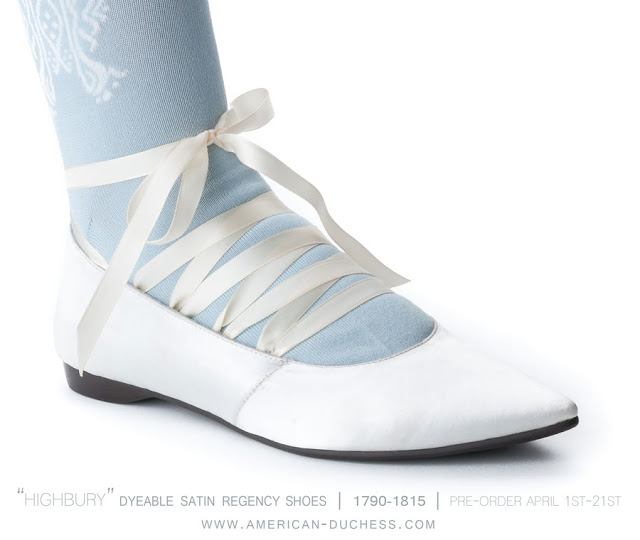
Shoes, Shoes, More Vintage Style Shoes!!!


American Duchess has done it again - another scrumptious reproduction shoe that I covet!

I don't even have any clothing for the 1790-1815 time period AND I still want these shoes.

Why?


They're dyeable, or paintable or otherwise able to be transformed! I'd love to create a pair of custom "art" shoes to wear - you can get away with so much fashion-wise when you're considered "arty"!

She's taking pre-orders right now - do you need a pair or Regency era shoes or do you need your very own wearable art?

Monday, April 1, 2013

Reproduction? Or Interpretation?


This is the cap/headdress/bit of foo foo (pick your term) that I created to wear with my 2013 conference dress. I was inspired by a piece I had first spotted on an online auction site, and purely by happenstance, it was one of many original garments on display on Saturday, when I wore mine - here's the original:


And a bit closer:

The original illustrates a number of very typical period techniques:

 - The use of coordinating but not necessarily matching materials. The center square is light and airy and the surrounding lace matches it nicely in weight and color.

- The lace and ribbon have been manipulated to to minimize the need for cutting, keeping the materials in one piece as much as possible; this maximizes the potential to deconstruct the cap and reuse the trims in a new garment.

- It has been constructed completely by hand, with what many would consider large crude stitches; this is intentional, again to aid in reusing the materials.


I duplicated these techniques - all the materials are from my stash, with the center square being a real salvaged piece - it was very dark and stained, but cleaned up beautifully. The materials are heavier in weight than the original, but coordinate well in both color and texture. I used just a single round of velvet ribbon, as mine was wider than the original. I also constructed my bow a bit differently, as I had a length of of the tiny ribbon which matched perfectly. The lace and ribbon are both left in long, uncut lengths.


It is stitched entirely by hand - in the car, on the way to Pennsylvania in fact!

When I was finished, I was a bit panicked - it seemed so small! But actually, it was just right, the same size as the original.

Many people would say I had created a reproduction of the original - but did I really?

I think a better example of a "reproduction" garment would be the two replicas of Emily Dickinson's famous white dress, commissioned by the Emily Dickinson Museum, to be displayed when the original became too fragile.
A pattern was created by painstaking measurement of the original dress and a muslin sewn to check the accuracy of the pattern.

Context Weavers, an English firm, exactly duplicated the fabric by punching a custom set of cards to be used on their Jacquard loom. The embroidered insertion and edging trim was reproduced by an American company.

While finding firms able to recreate the proper materials was difficult, a larger challenge was finding the funding - $10,000 for the two replicas.

Another good example is the Plimoth jacket, and even that's not considered to be a true reproduction - it's actually based on two separate garments.

I would argue that I created an interpretation of the original; the influence can be seen, but they are certainly not identical.

And I would further argue, that's the norm - there are vary few individuals with either the skill set or the budget to create true reproductions, we're all creating interpretations!