Saturday, August 11, 2012

Tower Adventure


Yes, really!!!

We won a trip to the top of the Mackinac Bridge, a once in a lifetime opportunity.

After signing  a waiver form and donning some oh-so-stylish Bridge Authority vests, our guide drove us to the south tower and opened the hatchway:


We then entered a very small elevator, maybe 2' x 3', which took us most of the way up the tower:


After that, we had to climb through a series of tiny hatchways and ladders, approximately 40' total:


And when we popped our heads through the final hatch, this was the view looking south, 552 feet above the water:


Looking north:


Looking towards home, Mackinac Island:


The cables are amazing:


One of the giant beacons on the top of the towers:


The towers don't allow a panoramic view to the east or the west:


Then it was time to climb down again, here's a shot of the entry hatchway:


If you look closely, you'll see the note, "This way out" penciled above this hatchway - it's a bit of a maze inside the towers and it all looks alike, it would be really east to get all turned around!


Every Labor Day, thousand of people walk across the bridge - the only day that's allowed, but only a handful of people are ever able to ascend one of the towers. I've been in a boat under the bridge and drove over the bridge dozens of times, but I never thought I'd be at the top of the bridge - it was a true adventure!


Sunday, August 5, 2012

In the Beginnings - An 1860's Fashion Show


Not too fashionable looking, am I?

Wash dress, apron, kerchief, and slat bonnet - basic garments that every female living historian should have and a great beginning to assembling a mid-19th century wardrobe.

Several years back, I was asked to present a fashion show at the annual Civil War event at Charlton Park, and I agreed - if I could do it my way.

So each show has a "theme" and this year I decided to address a question I frequently hear from spectators - no, not "Are you hot in those clothes?"  - but "How do you put together a wardrobe?"

We started by showing the underpinnings, chemise, corset,  drawers, petticoats, etc and explained WHY it's so important to have those layers before moving on to a dress - without the proper foundation, it's impossible to have the proper silhouette for the period.


We also discussed why under garments are the perfect place for a novice seamstress to practice - the skills used  can all be used in outer garments, and after all, if they aren't absolutely perfect, they won't be visible to the general public.


Skirt support was our next topic and also provided an opportunity to discuss research and trends in reenacting - we are both wearing corded petticoats, which for several years were the "in" thing, but further research has shown that by the war years, they were a bit of a rarity, having been replaced by the ubiquitous cage crinoline.


We also talked about the life cycle of garments - here we have what was previously a more fashionable dress, but it's become a bit faded and shabby and has now been relegated to work wear - think about the jeans that you now only wear when cleaning house. Clothing should be appropriate for the task at hand, why wear a fancy gown for messy tasks?

Another use for a dress past it's prime is to use it for yardage: just think how many aprons, slat bonnets, or children's garments a skirt could yield.


Removing that slat bonnet, apron and adding a plain white collar sure changed the look of my very basic dress!

Another versatile garment is a wrapper - great for early morning runs to the necessary without needing to get fully dressed and, due to the relatively loose fit, a very forgiving garment for the beginning seamstress. In this case, with permission, I shared the mistake made by the maker and her creative and appropriate solution - she had made her wrapper too short, but instead of discarding it, she added more fabric, running in the opposite direction to add length - it's a great solution, adds interest to the garment and looks intentional.


Here's another reason to start with a simple wash dress - you'll learn the skills to create a more fashionable gown. If you look closely, our basic dresses are very similar: fitted, gathered bodices and simple bishop sleeves. The difference is the finer fabric and bold trim of the dress on the left, as well as the stylish straw bonnet.

Here's another lovely example: striped sheer silk, with slim open sleeves worn over lace trimmed undersleeves, with a larger skirt support and accessorized with bonnet, gloves and reticule - she's ready to pay a call on friends!


 Again, the biggest differences between my wash dress and this gown suitable for visiting, are the fabrics and accessories - the rest is just details.


Despite having only a handful of models, I was able to share a huge amount of information with the viewers and they stayed to listen, standing in the sun on a 95 degree hot and humid day!

Monday, July 30, 2012

Emily's White Dress


We had an unusual event on Mackinac recently, a marathon poetry reading of Emily Dickinson - 12 hours, 1789 poems!

It was billed as "Emily meets Mackinac Island", but I suspect in many cases, it was actually Mackinac meeting Emily.

Emily Dickinson was known for her white dresses and a replica of a dress thought to have been worn by her was on display.


The dress is a white wrapper, dating to the late 1870's. For many years, the original dress was displayed at the Dickinson Homestead site, but it was eventually decided that it should be removed from display and conserved.

As the dress was an exceedingly popular object for visitors, the decision was made to create a reproduction, actually two, so they could be rotated for display.

A pattern was created by painstaking measurement of the original dress and a muslin sewn to check the accuracy of the pattern.

Context Weavers, an English firm, reproduced the fabric by punching a custom set of cards to be used on their Jacquard loom. The embroidered insertion and edging trim was reproduced by an American company - this relatively simple dress has over 14 yards of trim!

While finding firms able to recreate the proper materials was difficult, a larger challenge was finding the funding - $10,000 for the two replicas.

Having made reproduction garments myself, I can only wonder what it must be like to work with such expensive materials - I think I'd be terrified to touch it must less cut into it!

The dress made a wonderful focal point for the final reading of the day and several young ladies added to the  ambiance by wearing their own white dresses - it was a wonderful day!

Tuesday, July 24, 2012

Spiral - July 2012 Bead Journal Project


Each of my rune stones are intended to represent a force, for July, I chose to represent spirituality with a natural spiral - a snail shell.

The spiral has found its way into the art of almost all cultures, from ancient primitive rock carvings on all continents to today's corporate logos. They show up in Celtic art, native American petroglyphs, Nazca earthworks, Arabic architecture, Japanese rock gardens, Hindu spiritual texts, Australian aboriginal paintings and African art. Surprisingly, no religious or political group has claimed exclusive rights to the spiral. It remains non-sectarian, the spiral  seems to belong to everyone and excludes no one.


In terms of spirituality, the spiral symbol can represent the path leading from outer consciousness (materialism, external awareness, ego, outward perception) to the inner soul (enlightenment, unseen essence, nirvana, cosmic awareness).


The snail shell was found in a walk in the woods; we find many especially in the spring. the shell required a quite deep bezel to secure it and I echoed that depth in the surrounding roadwork, giving the overall piece a great deal of texture and dimension.


Some consider the spiral a symbol of the spiritual journey. It is also considered to represent the evolutionary process of learning and growing. It seems that life doesn't proceed in a straight line. The path of life more closely resemble a spiral. We seem to pass the same point over and over again but from a different perspective each time, always moving from our center, but yet still connected .

Monday, July 16, 2012

A Grand Celebration


It's a big deal to celebrate a 125th anniversary, you might even receive an official proclamation:

July 8 through July 14, 2012: Grand Hotel Week WHEREAS, established in 1887, the Grand Hotel on Mackinac Island continues to be one of America's premier vacation destinations; and,

WHEREAS, in 1957, the Michigan Historical Association designated the Grand Hotel as a state historical building and in 1989, the U.S. Department of Interior designated it a national historic landmark; and,

WHEREAS, known for world-class hospitality and its 660-foot front porch, the world's longest, the Grand Hotel and its staff enjoy more than 130,000 overnight guests each season, and have hosted five U.S. presidents; and,

WHEREAS, during this week, we join with the Woodfill and Musser families and all of the Great Lakes State in recognizing and celebrating the 125th anniversary of the Grand Hotel; we encourage Michigan citizens and visitors alike to visit this true, Pure Michigan attraction;

NOW, THEREFORE, I, Rick Snyder, governor of Michigan, do hereby proclaim Sunday, July 8 through Saturday, July 14, 2012 as Grand Hotel Week in Michigan.


And when you're Grand Hotel, you really need to celebrate in a "Grand" way, starting with a birthday cake - 125 foot long birthday cake! 


Not only was it dramatic and beautiful - it tasted great too!

There's a new barn on Mackinac, a joint venture between Grand Hotel and Mackinac Island Carriage Tours.

It will provide living accommodations for the big Percheron's that pull Grand's omnibuses, as well as the high stepping Hackney's.

In addition, it houses a beautiful collection of vintage horse drawn vehicles of all types, as well as large assortment of horse related items.


It was dedicated on Thursday and a large crowd was treated to a wonderful tour and reception.


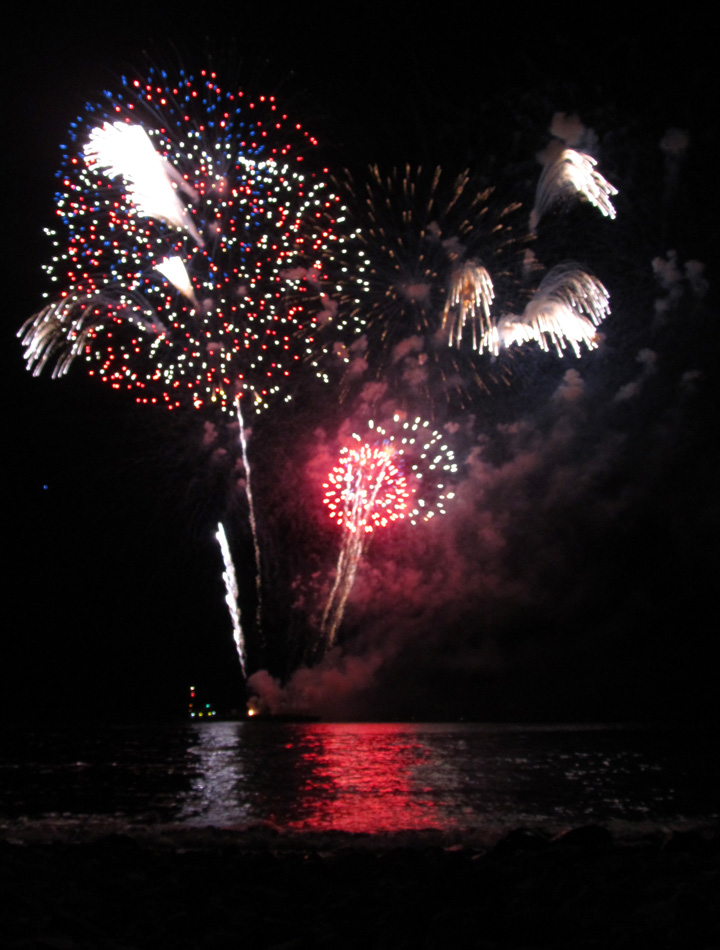
And then there was the fireworks - the production company had promised a show like no other in Northern Michigan, and they definitely delivered on their promise - it was simply spectacular!


The grand finale of the celebration was the Governor's Gala on Saturday evening:


A brief but heavy rain shower tried to interfere with the cocktail reception, but Grand employees know how to improvise - the party went on!


A six course dinner was next, with some brief comments from several former Governor's, as well as members of the Musser family.


Grand Hotel is a rare and wonderful thing - 125 years old, built of Michigan white pine, still standing and being used for it's original intended purpose - there's very few businesses that can say that.

There's only one known original room key in existence - and I was able to touch it - truly touching history.


Here's to Grand: may she last at least another 125 years and may I last to be at the 150th anniversary!

Sunday, July 8, 2012

What Would You Do?

While visiting a small, volunteer based historic site, we encountered the following:


We've been involved with Civil War living history for a long time, but we've never encountered this bit of information before.

A quick google search shows many sites that discuss this story, interestingly enough, all with the identical wording.

Most also include another story, crediting George Washington as the source of the statues:

"The origin of the lawn jockey has been traced back to George Washington and the famous midnight crossing of the Delaware River on Christmas night. According to the story, among those with Washington was a twelve year old African-American named Jocko Graves. Graves wished to accompany Washington and the troops on the crossing but Washington felt it was too dangerous and charged Graves with staying behind with the horses. He ordered Graves to keep a lantern lit so that the troops upon their return could find their horses. After the raid against the Hessians, Washington and the troops returned to find Graves dead from exposure, his light still lit and in his hand. Washington was so moved that he commissioned a statue "Faithful Groomsman" to be made and placed by the young man's grave at his home Mount Vernon."


The Civil War story apparently can be traced to an article published in 1984 in National Geographic magazine, unfortunately I have not been able to find a copy of that issue. The writer shares a family history of the Underground Railroad and the statues - anyone thinking "Quilt Code"?

It seems fairly obvious that this is probably just the equivalent of a Civil War urban myth, in fact, a spokeman for the National Underground Railroad Freedom Center in Cincinnati has said that "there is no truth to the idea that lawn jockeys were used as part of the Underground Railroad."

Furthermore, experts, such as Ann Chandler Howell, who for 20 years has researched the cast iron industry of the 19th century, remain skeptical and have been unable to find any foundry records of production of such statues prior to the war years.


I'm well aware that in an uncertain economy, cultural sites are increasingly forced to rely ever more heavily on volunteers and donations and are sometimes pressured to display items that may not fit the objectives of the site.


My question is what is an appropriate response.action when you encounter such obviously erroneous information?


I would really like to hear from all my readers - the living historians, the artists, the Island enthusiasts, etc.

Tuesday, July 3, 2012

Touring Michigan - The"Sunrise Side" or Lake Huron's Northern Shore


Even when you live in a beautiful, magical place, life gets hectic and stressful and you just need to get away. We had reached that point this past weekend and decided that a couple evenings by the campfire might just be the thing to put us back in a more relaxed frame of mind.

We decided to head southeast, to the shores of Lake Huron, the "sunrise side" of the state, which has a totally different feel than the Lake Michigan side - you won't find Starbucks or sushi here, but you will find plenty of natural beauty, history and lots of lighthouses.

Just a brief aside: Did you know that bags of marshmallows now come with the warning "Marshmallows are flammable. Please use caution when roasting this product". Are there really people out there that don't know this?

We spent a few hours canoeing the Thunder Bay River and had a great time viewing all the wildlife -so many great blue herons that we lost count, egrets, an otter, swans with cygnets, turtles and an amazing array of dragonflies.


Evening brought an incredible sunset - yes, even on the "sunrise side" thanks to the wide expanse of the river.


The next day we went on a different type of adventure - we climbed the towers of three different lighthouses!

First was the Old Presque Isle Lighthouse, one of the oldest surviving lighthouses on the Great Lakes. Built in 1840 by Jeremiah Moors of Detroit, the harbor light operated until 1871 when the keeper transferred to a new, taller, coastal lighthouse a mile to the north. The stone and brick tower measures thirty feet tall and eighteen feet in diameter and features spiral hand-hewn stone steps


The Old Presque Isle Light was found to be insufficient to shipping needs and a new light, the New Presque Isle Light was built in 1870 two miles further north. It's the tallest lighthouse tower accessible to the public on the Great Lakes, with a total of 130 steps leading to the top.

It's original third order Fresnel lens is still in place, I thought this inverted reflection of the shoreline caught in the lens was interesting:


Our final lighthouse of the day was 40 Mile Point Lighthouse, built in 1896. It was built in order to complete a chain of lights along Lake Huron's shoreline, so that ships would always be in viewing range of light.


That there was (and is) a need for lighthouses to add navigation is obvious - 200 feet from the lighthouse is a section of hull from the Joseph H Fay, which went down in the "Big Blow" of 1905 when a total of 27 wooden vessels were lost.


We had a wonderfully relaxing weekend, experienced adventures in nature and history, and went home refreshed and ready to face the fray once more - the "sunrise side" is a great place to kick back and rejuvenate!!!