Showing posts with label originals. Show all posts

Friday, May 23, 2014

2014 Conference Fabric - Fabric for the Ladies


One of the annual highlights of the Ladies & Gentlemen of the 1860's conference is the Saturday morning reveal of the "conference fabric" - each faculty member receives a piece, a dress length for the ladies and a different fabric for the men, typically enough to make a vest. It's always amazing to see how different the same fabric can look made up, depending on the choice of trims, placement, etc.

I always have both a sense of excitement and apprehension when I open up the package- like it or not, it must be made into a garment and worn. I'll admit u front, this is not a fabric I would have chosen for myself, but it has grown on me a bit as time has passed.

The fabric is a fine Italian cotton, with a lovely hand. I felt the colors would have been more typically used on wool or silk in the period, which was confirmed by Carolann when she described the fabric during the "Reveal".

With a fabric this bright and bold, there's only two options: attempt to tone it down or embrace and enhance the color. Most participants went with the tone it down option.

But when I went through my fabric stash and found this perfectly matching length of silk poplin, my choice was made: Embrace it or as a friend described it, "you bear- hugged it into submission".


I used a fashion plate (the lady on the left) and a sleeve detail from an original garment as inspiration.


My approach with the fashion plate was not to create a duplicate, but instead to interpret the details into my garment; I believe this is more the way fashion plates were used at the time, as opposed to being literally copied.


I did not have fabric to create the double skirt, but did have enough to place trim with the same dagged shape - I did not have this done for conference but added it later.


The bodice has a slightly pointed front and is trimmed with fancy buttons. I'll be posting more about the buttons in a subsequent post.


The sleeves are bishop style, with a twist - ending in points and brought back together at the cuff. The require a full undersleeve to hang properly, in this case, made of black spotted netting. Yes,I combined plaid and polka dots.


It wasn't clear in the fashion plate if the jacket was a true jacket or trim applied to look like a jacket. I decided to go with a true jacket, to give a little more versatility.
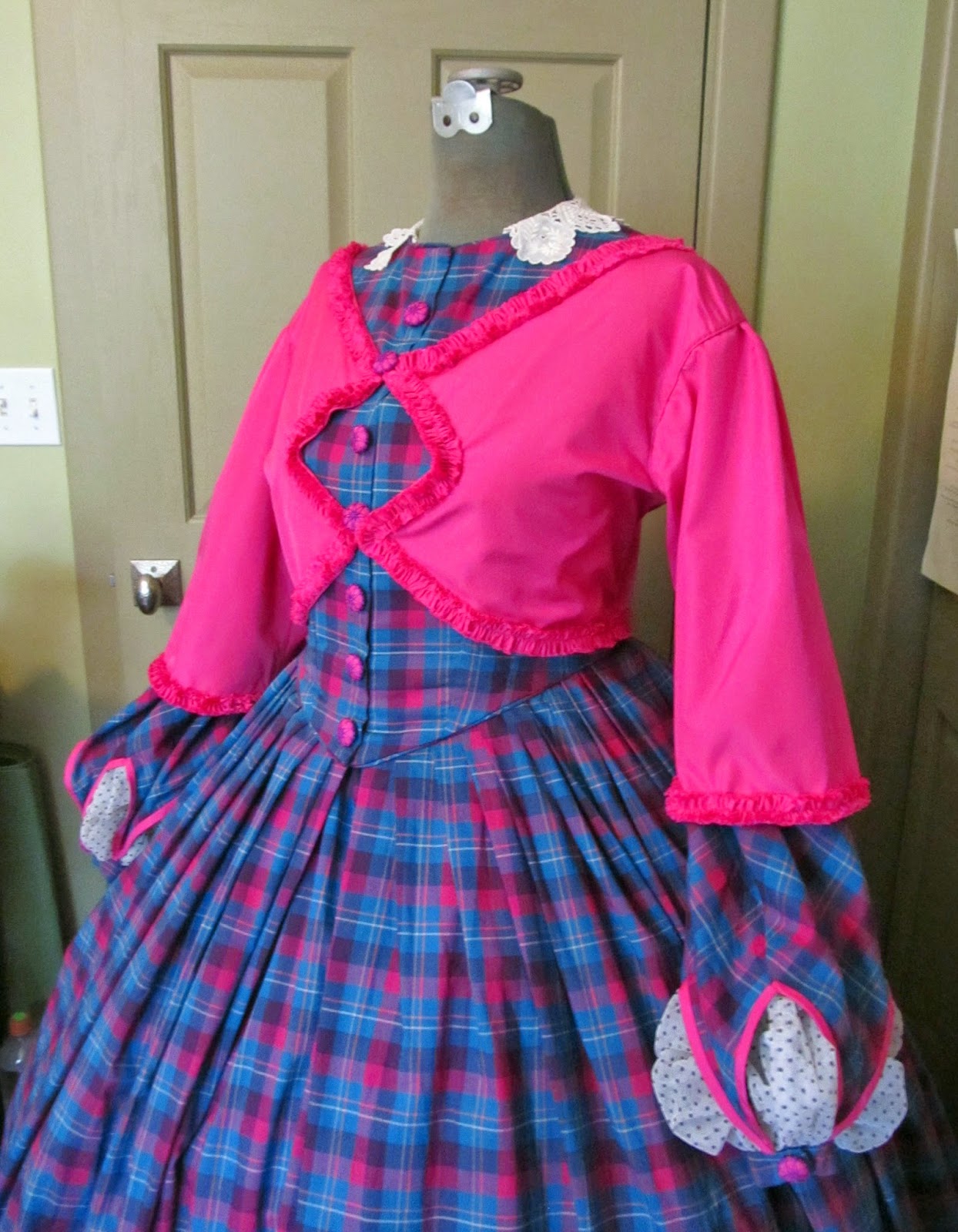


So there it is, the "diamond dress" - I'll be wearing it at Greenfield Village this weekend, see you there!


Sunday, January 26, 2014

High Flying Eagle


My head is in the clouds about this new find - a patriotic eagle!

I have a bit of an unusual hobby: attempting to pair up extant mid-19th century artifacts with the period publications that supplied the pattern. It's even better when I can manage to purchase the item, like the nightgown I recently received.


The yoke of the nightgown is adorned with extravagant  braidwork in an eagle design - a very popular motif during wartime, the Civil War specifically.


Here's the pattern, as published by  W. F. Sherwood & Co. of Chicago Illinois, circa 1865, in a mmanufacturer's sample book of embroidery and beading patterns - Sherwood's Impression Powder and Perforated Patterns, For Printing all Kinds of Designs for Braiding, Embroidery and Beading.

The entire pamphlet is available at the Antique Pattern Library, a fabulous site with hundreds of publications from a large variety of eras - all for FREE - although donations are accepted and encouraged.


I found it interesting that the nightgown was in Canada; the seller was not able to provide any provenance for the garment having purchased it at a "jumble sale". It would be lovely to know if the nighty was created in the States and migrated to Canada or did the pamphlet itself do the traveling?

The maker did not use the suggested cuff pattern and used a different motif (not in the pamphlet) of what appears to be a dove taking a nosedive on the back yoke - possibly some type of political comment?


I've been  in progress on my own nightgown for quite some time now, using a Sherwood design, although not the eagle pattern - maybe some year I'll be able to share that with you!


Sunday, November 3, 2013

Whatsit Followup


Here's the "whatsit" that has generated so much conversation here, on the Civil War Needleworkers forum and on the Antique Pattern Library regarding what this object actually is.

My first thought, echoed by others,  was some type of lampshade cover, but the gas and kerosene lamps of the era required a central vent which this object does not accommodate.


Another suggestion was a skullcap:


Um, probably not!

A cover for a domed glass paperweight, again, probably not:


One plausible theory was a cover for wire food safe. I don't have an antique wire food safe, but I do have a rattan version:


My problem with this theory is the handle - like the lampshade cover there is no accommodation for the handle.

Other suggestions include workbasket cover, pillowcover, footstool cover and finally a piano stool cover:


And I do believe we have a winner!!!

Despite having a piano stool, it had not occurred to me to try it on there - but when I did, it was a perfect fit!

It's my opinion, based on materials, construction techniques, color and style, that this cover dates to the late 1870's - 1880's and reflects the Victorian craze for all things "Oriental".


I feel it was constructed, at home,  by a middle class lady, to ornament her parlor - which was probably not as ornate as the parlor seen above. She most likely used a published pattern for the crochet and then added the purchased chenille fringe.

A note on the fringe: It was suggested on one of the forums that the chenille "tails" had been knotted in place, not woven as I suggested. However, a closeup photo of one of the tassels clearly shows that it was woven in when the trim was constructed:


Wouldn't it be a wonder to have such trims available for purchase now!

Once I found the proper term - music stool, not piano stool - I found a number of patterns in the period magazines, using a variety of techniques:


This one in crochet even has a central diamond pattern similar to my example!


Thank you so much to everyone who offered suggestions - it's been so much fun exploring the possibilities

Sunday, May 12, 2013

Capping It off


I obtained this mid-19th century night cap via an online auction and while it has some condition issues, it still has plenty to tell us regarding period attitudes and concerns.

During the 19th century, night caps were worn by all ages and social classes. They were designed to fully cover the head and tied under the chin - they closely resemble the day caps worn by women in the 1700's. Night caps were nearly always constructed of white fabric, which allowed for easy washing and boiling if necessary. They were a functional item, intended to confine the hair, protect the bed linens from the oils and pomades used to dress the hair and provided warmth in chilly bed chambers.


The seller did not provide any provenance for this cap, I believe it may be a museum deaccesion due to the number penciled on the tie.

This cap is an excellent illustration of the relative cost of materials versus cost of labor during the period. A cap of this style would usually be constructed with three pieces of material: the brim, crown and neck curtain. This cap has been extensively pieced - 14 pieces in fact - including a tiny triangle, with sides less than 3/4" in length. All the pieces have been very carefully sewn, the stripes matching perfectly and all seams finished with no raw edges visible. A great deal of time was spent in making the minimal amount of available materials (probably recycled from a previous garment) work - a very 19th century mindset.


It's not something we see done very often in modern interpretations of historic clothing; we typically purchase new textiles and go buy more if we run short. It's an option I'm increasingly trying to incorporate into my garments: piecing materials, reusing materials, tiny details that add to the authenticity!

Night cap available for purchase here.

Monday, April 1, 2013

Reproduction? Or Interpretation?


This is the cap/headdress/bit of foo foo (pick your term) that I created to wear with my 2013 conference dress. I was inspired by a piece I had first spotted on an online auction site, and purely by happenstance, it was one of many original garments on display on Saturday, when I wore mine - here's the original:


And a bit closer:

The original illustrates a number of very typical period techniques:

 - The use of coordinating but not necessarily matching materials. The center square is light and airy and the surrounding lace matches it nicely in weight and color.

- The lace and ribbon have been manipulated to to minimize the need for cutting, keeping the materials in one piece as much as possible; this maximizes the potential to deconstruct the cap and reuse the trims in a new garment.

- It has been constructed completely by hand, with what many would consider large crude stitches; this is intentional, again to aid in reusing the materials.


I duplicated these techniques - all the materials are from my stash, with the center square being a real salvaged piece - it was very dark and stained, but cleaned up beautifully. The materials are heavier in weight than the original, but coordinate well in both color and texture. I used just a single round of velvet ribbon, as mine was wider than the original. I also constructed my bow a bit differently, as I had a length of of the tiny ribbon which matched perfectly. The lace and ribbon are both left in long, uncut lengths.


It is stitched entirely by hand - in the car, on the way to Pennsylvania in fact!

When I was finished, I was a bit panicked - it seemed so small! But actually, it was just right, the same size as the original.

Many people would say I had created a reproduction of the original - but did I really?

I think a better example of a "reproduction" garment would be the two replicas of Emily Dickinson's famous white dress, commissioned by the Emily Dickinson Museum, to be displayed when the original became too fragile.
A pattern was created by painstaking measurement of the original dress and a muslin sewn to check the accuracy of the pattern.

Context Weavers, an English firm, exactly duplicated the fabric by punching a custom set of cards to be used on their Jacquard loom. The embroidered insertion and edging trim was reproduced by an American company.

While finding firms able to recreate the proper materials was difficult, a larger challenge was finding the funding - $10,000 for the two replicas.

Another good example is the Plimoth jacket, and even that's not considered to be a true reproduction - it's actually based on two separate garments.

I would argue that I created an interpretation of the original; the influence can be seen, but they are certainly not identical.

And I would further argue, that's the norm - there are vary few individuals with either the skill set or the budget to create true reproductions, we're all creating interpretations!

Sunday, May 20, 2012

Taking to the Water - Part 6


The goal of this series, "Taking to the Water" is to construct mid-19th century bathing costumes, and I think it's time to share some images of ladies who have done just that!

I found the photo above online and it's one of my favorites - I think this is a great interpretation, with a definite nautical feeling, but yet feminine with with the ruffles and scalloped hem.

The next several photos were taken at the 2009 Ladies and Gentlemen of the 1860's conference. You'll notice quite a range of trim options and trouser styles:


Some of the ladies did not intend their costumes for bathing, but for gymnastics or other physical pursuits.


Here's another found online, and another great creation, although the short sleeves are not appropriate for an 1860's interpretation.


Here's one created from this year's "conference fabric":


And here's the original used as inspiration:


The original is a short, pleated skirt dress made of wool with trim of wool braid. The trousers have a yoke of cotton, to reduce bulk at the waist and are lined with a polka dot cotton - a detail included on the reproduction trousers!


I have my wool and I'm currently looking for coordinating wool braid (that I can afford!) and I will be sharing my very first costume diary with you throughout the construction phase - so more to come!

Sunday, April 22, 2012

Taking to the Water - Part 4


Original bathing costumes from the mid-19th century are vanishingly rare, but I did manage to find a few!

The example above is said to date to the 1850's and there certainly is a resemblance to the fashion plate from 1858 I posted previously.

Here's a couple from the 1870's; I especially like the Greek key trim on the second.


In some locations, suits could be rented - the photo below was taken at Coney Island, supposedly in 1865. Look at the right side of the sign "Fancy Flannel Bathing Suits". 


Peter Tilyou and family moved to Coney Island in 1865 to establish the Surf House, a hotel and restaurant which sold Bavarian Lager for five cents. Tilyou treated those, who rented a bathing suit for 25 cents, a free bowl of homemade clam chowder on the theory was that those that were hungry would spend more money for food at his restaurant. He built bath houses nearby for those who wished to change from their city clothes into fancy full length flannel bathing suits. "Signs on the beach warned "Bathers Without Full Suits Positively Prohibited by Law."


I love this tinplate image, but it really makes me wonder - did these ladies choose to make matching suits or are they rentals?

Here's a CDV image - I was surprised at how short a skirt the lady on the left is wearing. The lady on the right almost appears to be wearing an outfit that was remade from an old dress, much like can be done when  making a wrapper. Her trousers might have been made by cleverly piecing fabric salvaged by both shortening the skirt and removing a removing a breadth of fabric.


The question of attire for the gentlemen attending our bathing party has been an issue:


The commonly held reenactor notion, that men always swam in the nude is NOT an option and my research is showing that it's not necessarily always correct - I have found both descriptions and images of bathing suits for men.

Here's a suit documented to 1860: 

And you've got to love this image - isn't he cute! 

Here's an 1870 advertisement (and compare the lady in the center to the original 1870 suit above)


 These gentlemen apparently shopped at Lord & Taylor's!


Salt water bathing was a rather novel idea in the late 1860's and 1870's.  Those that came to the beach were apprehensive of even sticking their toe into the sea for there were those that warned that sea bathing might "leach away the essential salts of the body." They turned to a noted physician named Dr. Durant for reassurance. He advised that "the bathing dress should be made of woolen fabric...as it retains the heat of the body and therefore prevents a too rapid evaporation. Maroon and blue are the proper colors as they resist the corrosive and bleaching effects of salt water. Some authorities recommended twilled flannel, in browns, blues and grays, and stressed the desirability of broad-rimmed hats to fend off the sun and wind, as well as shoes to guard against the nipping of crabs.